
PORT FILE / 001
Felixstowe
A major container gateway on England's east coast, positioned to handle large volumes of international container traffic.
FTX
TripExploral is a different way to think about movement. Not just destinations, but the routes, weather, streets, airports, places, people and small discoveries that make a journey worth remembering.
Long before a product reaches a shop, a home, a restaurant or a traveller's suitcase, it may have already crossed an ocean.
Britain's ports form an enormous network of maritime gateways connecting the country to Europe and the wider world. Behind every container is a route, a vessel, a terminal, a logistics operation and thousands of decisions that keep international trade moving.
TripExploral goes beyond the destination to explore the infrastructure behind movement.

A modern cargo port is a constantly moving environment. Ships arrive from international routes while cranes lift containers from decks, terminal vehicles carry them across enormous yards and freight networks prepare them for their next destination.
Every section of the operation has a purpose. The harbour is only the beginning.
Cargo ships connect ports across oceans and international trade routes.
Specialised terminals organise the flow of containers and freight.
Road and rail corridors carry cargo beyond the port.
Across the United Kingdom, different ports serve different industries, routes and forms of cargo. Together they create a maritime network that connects Britain's economy with international markets.
A major container gateway on England's east coast, positioned to handle large volumes of international container traffic.

A strategically positioned southern gateway supporting containerised freight, automotive movements and maritime connections.

A western maritime gateway connecting cargo movements with regional distribution networks across the UK.
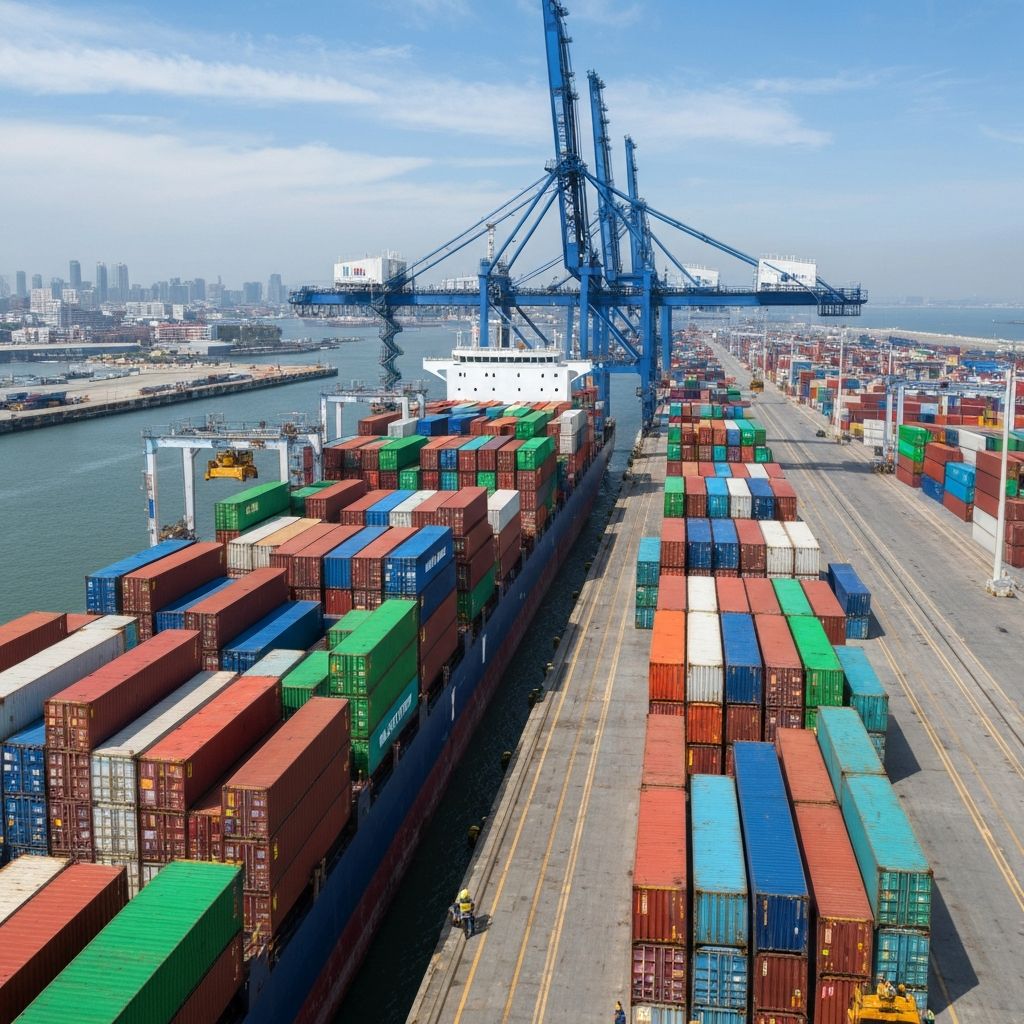
A container yard may look like an organised maze of steel boxes, but beneath the apparent simplicity is a carefully coordinated system.
Containers must be identified, positioned, moved, inspected and transferred according to their destination and the requirements of the cargo they contain.
Some continue their journey by road. Others move towards rail terminals. Some are temporarily stored before their next stage.
From the shoreline, port cranes can appear almost architectural. Their purpose, however, is intensely practical: transferring enormous quantities of cargo between vessels and terminal operations.
The scale of modern shipping means that efficiency depends on timing. A vessel, a crane, a terminal vehicle and a wider logistics network must operate as parts of the same chain.
EXPLORE PORT OPERATIONS →
Cargo crosses international waters aboard a vessel travelling between maritime gateways.
Containers enter the port and become part of the terminal's organised movement system.
Documentation, regulatory checks and customs processes form part of the cargo journey.
Cargo continues through road or rail networks towards its next destination.
The journey ends when the cargo reaches the business, warehouse or customer it was intended for.


The port may be where cargo enters the country, but it is rarely where its journey ends.
Distribution centres, warehouses, fulfilment facilities and transport corridors extend the maritime network far beyond the coastline.
This connection between sea, land and city is what makes modern logistics possible.
A port is a machine made of people as much as steel. From vessel crews and crane operators to engineers, customs teams, logistics planners, drivers and warehouse staff, thousands of roles contribute to the movement of goods.


Explore the ports, routes, cities and systems that connect destinations around the world. Because travel isn't only about where people go. It is also about everything that moves around them.
EXPLORE THE MARITIME WORLD
Explore destinations through the details that usually get left behind. Architecture, streets, neighbourhoods, food, movement, atmosphere and the moments between the landmarks.


Two places may be thousands of kilometres apart, yet the journey between them can become part of the destination itself. TripExploral looks at movement as an experience, not merely a calculation.
From the first airport announcement to the moment a new city appears beneath the clouds, flying is more than getting from one place to another.
Discover the rhythm of the United Kingdom's busiest air routes, the airports that connect them, and the airline experience that turns the distance between cities into part of the adventure.

Major UK gateways create a network of routes connecting passengers with Europe, North America, Asia, Africa and destinations beyond.

A global departure point where international routes, business travel and leisure journeys converge.

A major northern gateway serving travellers across the United Kingdom and international destinations.

A northern European gateway where city breaks and international journeys begin.

There is a strange moment after takeoff when airports become tiny, roads become lines and familiar places disappear beneath the clouds.
This is where the journey changes character. The destination is no longer behind you and the new one has not yet arrived.
A memorable airline experience isn't only about the aircraft. It is the sequence of small moments surrounding the flight.
Start the journey before reaching the departure gate.
Shops, lounges, announcements, departure boards and anticipation.
The point where the city falls away and the journey becomes airborne.
New signs. New streets. New sounds. The second chapter begins.

The wheels touch the runway. The cabin doors open. The airport begins moving around you.
A successful flight doesn't simply deliver you somewhere. It gives the destination a beginning.
EXPLORE THE ROUTE →Discover a smoother way to travel from the United Kingdom to the places you've been thinking about. Choose your route, step aboard and let the journey become part of the destination.
DISCOVER FLIGHTS ↗
Places to sleep become part of the story when they are chosen for character, location and atmosphere instead of simply checking a box on an itinerary.
Follow the late trains, midnight streets, rooftop lights, harbour walks and places that become completely different when the sun disappears.
Direction is useful. Curiosity is better. Keep both close.
Don't photograph everything. Photograph what you will want to remember.
A small piece of paper that can mark the beginning of an entirely different story.
Every destination eventually gets a song attached to it.
The best discoveries are sometimes the streets you didn't plan to take.
Pack light enough to leave room for whatever the journey gives you.
The city is quieter. Streets are nearly empty. The first cafés begin opening their doors.
Commuters arrive, markets become louder and the city begins revealing its rhythm.
Lunch tables fill the streets and every route seems to become slightly slower.
Buildings change colour, windows begin glowing and the city becomes photographic.
The tourist map disappears. What remains is the city as locals experience it.
Not everything valuable on a trip can be booked in advance. Leave some space for unexpected turns.
Sometimes the most useful travel guide is simply getting outside and paying attention.
Ask questions. Listen to recommendations. Local knowledge rarely looks like a five-star review.
The supermarket, train platform, corner café and quiet street may become your favourite memories.
There is always another street, another city, another coastline and another story waiting somewhere beyond the route you already know.